Let's talk about scars. Most of us acquire at least one scar or other throughout the turbid frothing streams of our lives: a round white scar acquired from an overly large pox of the chicken persuasion, a thin white line from some form of surgery, a reddish mark or nick from a mishap with a pair of scissors or while carving a pumpkin for Halloween. Such marks fade with time and growth, becoming paler and thinner and perhaps eventually vanishing until the skin is more or less as unblemished as before. The marvels of modern medicine ensure that most serious wounds and surgeries leave the smallest and least noticeable scars possible.
Yet the modern mentality and mythos surrounding scars seems to view them as hip and sexy indications of a person's dark, angst-ridden, mysterious past. That is, of course, speaking of characters who possess strategically placed and not-too-disfiguring scars. Shall we take a look at a few of these?
There is the sullen hero of Final Fantasy VIII, Squall Leonheart, with a great huge brown scar slashed diagonally across his face. The source of this scar is a scene of drama and fighting and hacking and slashing with gunblades and in general, actually, since I never did play FFVIII, I'm probably not really qualified to go harping on about it. But from what I do know, I'm fairly sure that Squall gets this scar to 1) make him look badass and 2) form nice symmetry when the dude who gave it to him in the first place receives a similar scar going diagonally the other way across his face. Of course, that whole point #1 about looking badass goes back to my original intent in starting this post: What is it about having a huge scar slashed across a guy's face that makes him "badass"? Is it the implied macho-ness of having survived such a near-deadly wound and coming out without permanent damage to the eyes? The thrill of a near-miss? That he must be pretty damn manly to have been in a fight and earned such a scar in the first place?
Himura Kenshin of the anime Rurouni Kenshin is a prominently scarred character, and this is an example of a scar with a purpose, history, background, and effects upon the character's life. Kenshin used to be a political assassin during the war-torn Bakumatsu era and helped to bring about the transition into the Meiji Era, and was renowned as a highly-skilled and terrifying swordsman, the Hitokiri Battousai, identifiable by the cross-shaped scar on his left cheek. The back story of how he acquired this scar—and changed from being a feared assassin to a gentle wanderer—is very dramatic, very full of character-driven passion and belief, and very excellent. Naturally having a prominent scar in a difficult-to-hide place complicates Kenshin's life for there are those with grudges or glory on their minds who seek to best the legendary Battousai—particularly as he has taken an oath to never kill again.
Dilandau Albatou of the anime Vision of Escaflowne gets sliced along the left side of his face (what it is with the left side, anyway?) during a skirmish with Van Fanel, and because Dilandau is already an unstable narcissistic freak, this wound sends him over the edge and let the animators have a field day competing to see who could draw him with the most psychotic expression short of foaming at the mouth. For Dilandau, the scar that he so often strokes thereafter is an unsightly mar upon his beautiful face and is entirely Van's fault, and fuels his obsession for killing Van throughout the series.
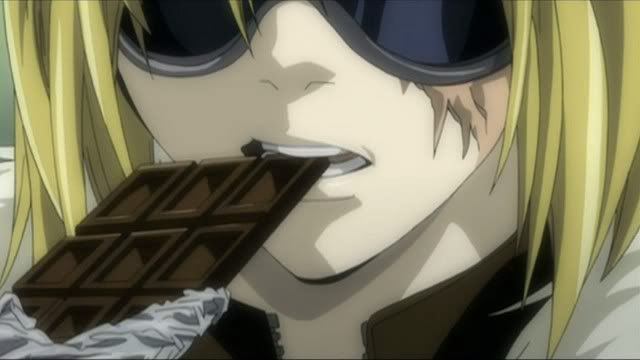
In the anime series Death Note, the character Mello's face becomes scarred through spoilerific means. Here we seem him munching on chocolate, as usual. But it should be noted that after he becomes scarred—or perhaps more accurately because of the events that lead to his scarring—Mello becomes more obsessive and underhanded with regards to his goals. In this case, it is events that lead to his change in personality and the scar serves as a symbolic reminder.
In Bleach, Grimmjow is scarred by Ichigo. A lot. In this case, however, it's not just a single fine slice across his face, but massive owwiness. While I can't speak for all fan art, what fan art I've seen of Grimmjow is typically not of him crisped and burninated and mono-armed. Clearly his amount, type, and location of scarring goes beyond aesthetic appeal and perhaps becomes either grotesque or just simply not "sexy." Is this because there is something tragically attractive about near-perfection or perfection-now-marred, but not immense or intense amounts of disfigurement? And yet fan art of Mello in his scarred state is more prevalent than that of scarred!Grimmjow—is it because Mello isn't also missing an arm and is more femininely androgynous than machismo-manly Grimmjow?
Moving beyond anime, there is Inigo Montoya of The Princess Bride by William Goldman, a Spanish man who has parallel scars on his cheeks—one on each cheek, vertically, scarred for life as a child, he was. For him, these are scars of remembrance of vengeance, for the six-fingered Count who gave them to him also killed his father.
We can take a look (once again) at Harry Potter, who bears a zigzag scar on his forehead that is the source of much pain (physical, mental, magical, etc.) in his life. What is this mystical scar? Why, it marks him as the Boy Who Lived, the only person ever to have survived the Killing Curse, and cast by the Dark Lord Voldemort no less. Later on it's revealed to have several sorts of magical properties linking him back to Voldemort (hurting when Voldemort is nearby, enabling Harry to catch glimpses of what Voldemort's doing, etc.), and is also a symbol of Harry's mother's love for him. It becomes a symbol and a plot device and an identifying mark all rolled into one lightning-shaped stamp on his forehead.
In the Asian ball-joint doll community, many doll-collectors have an obsession with painting their dolls to have scars, with or without a story behind them. The methods of accomplishing scarring range from the purely cosmetic (simply painting a scar onto a doll's face or body) to physical modification (actually carving a scar into the resin using a knife). Facial scars slashed across an eye, along the jaw, or over the bridge of the nose are a particular favorite.
The Volks company released two versions of an extremely limited and highly-sought-after scar-faced variant of their original Cecil doll, creatively named "Cecil the Scarface". How does Scarface differ from regular Cecil? His right eye is mostly closed and a great huge gash is carved into his face—literally. (He also has a scar carved into his right arm.) This scar is a deep, jagged-edged groove that is typically painted some form of orange-red-brown, as though this poor doll is doomed to have a perpetually unhealed wound sawed across his eye. (Incidentally, both versions of Cecil the Scarface were sold with a special "blind eye", gray with a white pupil, that could be used for the wounded eye.)
But as mentioned in Grimmjow's case, scars cannot be disfiguring or else they become too disturbing. Take a look at the Anakin Skywalker of Star Wars Episode III: According to Krispy, he acquired the scar over his right eye in battle during the Clone Wars in a light saber duel with Asajj Ventress, shown in the Clone Wars cartoon series. His scar doesn't play any kind of role in the third movie and I haven't watched enough of the Clone Wars series to determine if it has any affect there either, but fans seem to accept and like his scar as far as I can tell.
But once Anakin Skywalker gets toasted and he morphs into Darth Vader (as it were), well, he's totally covered in black so that not a speck of skin shows, from face to feet. It would be too disturbing for the audience and anyway he's not attractive anymore. In a way, he very much resembles V from the movie V for Vendetta, also a victim of full-body burns who also covers himself from head to toe so that none of his burns are visible—but V probably belongs to another post some other time. For now, it's enough to see Anakin's descent from his pedestal. I mean, come on, you find tons of pictures, fan art, screencaps, etc. of Anakin and Darth Vader, but not of Anakin-after-the-lava-pit or Darth-Vader-sans-mask-and-helmet. People want him either whole and handsome or dark, mysterious, and completely covered.
The physical scars of real-life can mean anything, including nothing. I don't think twice about this weird little scar I've had on my hand for several months now, originally attained from scraping my hand on a protruding bit of wire mesh. This event was hardly traumatizing or life-changing and it was just an owwy on my hand that healed pretty quickly and didn't even require a band-aid, and yet the tiny slightly discolored mark persists. But scars earned from bullets taken in warfare or in the line of duty are proverbial red badges of courage and honor and duty.
But in the world of fandom, at any rate, scars seem to be as cosmetic and varied as eye- and hair-color. They tend to be of mysterious origins rooted in angst and trauma. But not too much scarring, and not too intense a scar. They can be marks of honor or remembrance or vengeance or brotherhood, of ritual or tragedy, or maybe just incidental, accidental, and forgettable—except that if a scar is either shown or mentioned, chances are it's not the latter.
This post is brought to you by the fact that one of our characters does have scars, acquired through traumatic means, and which definitely do drive him indeed along his thorny path of vengeance. But really it's not the scars that are important to him or about him: it's what happened to him in the past. (Incidentally his scars are not in a usually visible place, unlike most of the characters named above. I tried to think of characters who have hidden scars, but none readily came to mind. If I manage to think of a few, there may be forthcoming Scar Post Part II. Oooh, that rhymed.)

Showing posts with label manga. Show all posts
Showing posts with label manga. Show all posts
8.06.2008

6.06.2008
Ulterior Motives gets Krispy Weak in the Knees
Villains/Antagonist issues. We're having them. Maybe Alz isn't having them, but I am. To put it simply, I'm not too keen on our bad boys, and that is a problem. For me to get any real meat out of them, I need to feel something about them and I'm hovering around indifferent. So in an attempt to figure out what it is about our antags that is making me give them the brush off, I've been thinking about the antags that I do like and what it is that makes me go ga-ga over their shady, shady ways. Brace yourselves, this may be a long post.
First problem, I don't like a lot of villains. What can I say? I'm a sucker for the Good Fight, though I also do like inflicting pain... *Ahem* Most bad guys are just not that interesting to me (though there are always exceptions), and when I do like antagonists it's usually based, at least at first, on some quality that I suddenly and inexplicably latch on to and become wholly fangirlishly obsessed with. Usually this "random quality" is the shallow one of being drop dead gorgeous (this pertains mostly to the visual medium). Or shiny. Or BOTH. Another prerequisite is that they are usually quite capable somehow of pwning you dead. There's a sense of power there, a sort of lofty arrogance. I think the key, though, for the ones I'm really head-over-heels over is shadiness. Ulterior motives coupled with one or all of the aforementioned qualities and I'm enlisting in that Dark Army.
Let's take a look at a few of them. These are all going to be ani/manga references because I can't for the life of me think of a book antagonist/villain who does anything for me. I can't even think of one that I really hated, which means I should maybe read more? :/
*Um, SPOILERS up the wazzu--though I'll try to keep it vague/general--for Code Geass, Loveless, Death Note and Bleach to follow.*
Schneizel El Britannia (Series - Code Geass: Lelouch of the Rebellion, R2)
Seimei Aoyagi aka Beloved (Series - Loveless)
*
Still, this sort of thing isn't hard and fast. In a recent discussion with Alz while I was in the midst of writing this post, I considered a few other antagonists, who by the above mentioned qualities should totally float my fangirl boat but they don't. Here's one.
*
Light Yagami (Series - Death Note)
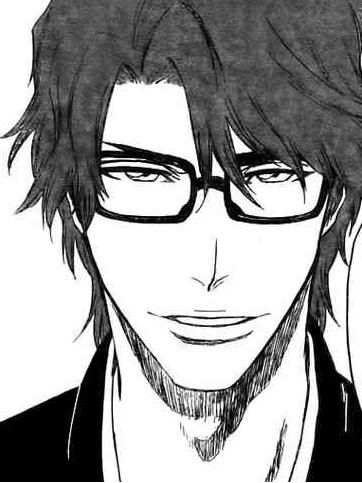
Aizen Sousuke (Series - Bleach)
*END spoilers*
In conclusion, Alz and I have no idea what we're talking about. When I started this post, I thought I'd figured out the qualities that help me like them. I realize now, at the end of this post and after discussion with Alz, that it's not that simple. We think there's just a certain ineffable characteristic that really gets me weak in the knees. Our current antagonists lack that spark, making it difficult for me to breathe life into them. I can talk motivation and pasts with Alz, but when I don't care, all those details come across as character stats. It's fine for describing the antags in a nutshell, but I have my doubts about how that will hold up written out in depth if I have no feelings for the characters themselves.
Still, this exercise was good for me because it made me realize that I have a thing for people with ulterior motives. This might not be easy to put into our antags here (since I need to actually know what our kiddies are up to in order to write it), but it's something to keep in mind.
First problem, I don't like a lot of villains. What can I say? I'm a sucker for the Good Fight, though I also do like inflicting pain... *Ahem* Most bad guys are just not that interesting to me (though there are always exceptions), and when I do like antagonists it's usually based, at least at first, on some quality that I suddenly and inexplicably latch on to and become wholly fangirlishly obsessed with. Usually this "random quality" is the shallow one of being drop dead gorgeous (this pertains mostly to the visual medium). Or shiny. Or BOTH. Another prerequisite is that they are usually quite capable somehow of pwning you dead. There's a sense of power there, a sort of lofty arrogance. I think the key, though, for the ones I'm really head-over-heels over is shadiness. Ulterior motives coupled with one or all of the aforementioned qualities and I'm enlisting in that Dark Army.
Let's take a look at a few of them. These are all going to be ani/manga references because I can't for the life of me think of a book antagonist/villain who does anything for me. I can't even think of one that I really hated, which means I should maybe read more? :/
*Um, SPOILERS up the wazzu--though I'll try to keep it vague/general--for Code Geass, Loveless, Death Note and Bleach to follow.*
Schneizel El Britannia (Series - Code Geass: Lelouch of the Rebellion, R2)
2nd Prince of Britannia, and all he's really guilty of is looking kinda evil. Early in the first season, he is set-up to be an antagonist when he is mentioned as knowing something about the MC's mother's assassination. Then for the rest of Season 1, he's not much more than someone who's connected to characters in play. He doesn't physically show up until the last third of the season, and when he does, he's, well, very princely. He's courteous, charming, and not only looks nice but actually IS nice to everyone, including his subordinates. He doesn't look smirky or otherwise nefarious the way he kind of does in his brief appearance in the opening. Yet, his actions, while not outright suspect, indicate much calculation and manipulation. More hints are also dropped about his dealings, and we're reminded that he is the only person from our MC's past who ever beat the MC in a game of strategy. This continues to build the expectation that he will eventually challenge the MC in some huge, plot-turning showdown of doom (though not Doom because Schneizel is NOT the main antagonist).
But see, everything is hearsay, speculation, and rumor. While he may have manipulated a few events, he manipulated them all towards the good of his country with minimal bloodshed, and did I mention he's ridiculously nice to like everyone? He's every bit the competent and dutiful prince, except with this undercurrent of his being up to something. It's this "what is he up to?" question that has me obsessed with this guy. His motivation and his true intentions/goals are as of yet still unclear.
Really though, his actions in the series wouldn't seem half as shady if he didn't also look kind of evil/shady to begin with. Thanks opening credit animation for preemptively biasing me! Alz has suggested that perhaps we're horrible people for expecting the worst of him simply because he looks it. Come on though, no one this good-looking is that nice without ulterior motives! Either way, I support the Rebellion, but Schneizel has me considering switching sides.
Seimei Aoyagi aka Beloved (Series - Loveless)
I actually wasn't interested in him much until recently--that is, until I reached a point in the series where it became very clear that he was one big Antagonist, if not The Big Bad of the series. The start of Loveless is focused on the MC (Ritsuka) and his introduction to the Sacrifice-Fighter dyad world Seimei belonged to. Character and plot developments all more or less tie into the mystery of Seimei's murder, and so for the first volumes, Seimei was little more than a plot and character development point for me (though a pretty one). Plus, all we learn of Seimei at first is that he was murdered, he was kind and deeply loved his little bro (the MC), and his dyad, Team Beloved, was reputedly unbeatable.
Flash forward some chapters/volumes and Seimei has me by the throat and wholly fascinated. He emerges out of background character status to Lead Villain. Hints get dropped about his having abusive, sadistic, and neurotic tendencies. Where the MC only knew him as a kind, protective, and affectionate older brother, others knew Seimei as cruel, merciless, and destructive. He was close to no one, and as Ritsuka (as well as the readers) begins trying to reconcile Seimei's two vastly different personalities (gentle and kind brother vs. sadistic and cold Sacrifice), surprise! Seimei turns out to be very much alive and up to no good.
His motivations and intentions are murky. He retains a strong attachment to the MC, saying that Ritsuka is the only person he truly loves and cares for. It makes for a pretty twisted relationship since Seimei is of the mind that "you hurt the ones you love most" and is bent on testing Ritsuka's love for him, but that appears to be only part of it. There's something bigger afoot that has yet to be revealed. Shady, right?
And he is still really pretty, and it was in fact a rather pretty panel of him that re-caught my attention. Then, he had me and it was over. With a name like Beloved, Seimei just commands and demands love and despair.
*
Still, this sort of thing isn't hard and fast. In a recent discussion with Alz while I was in the midst of writing this post, I considered a few other antagonists, who by the above mentioned qualities should totally float my fangirl boat but they don't. Here's one.
*
Light Yagami (Series - Death Note)
Actually, quite a fascinating "villain," Light is the boy genius MC of the series. The series is a psychological thriller (with a touch of the supernatural) where Light gets his hands on a Death Note (a notebook which kills the human whose name is written in it) and decides to use his newfound power to create a better world. What makes Light an interesting character is that his intentions are good, but power and his drive towards his goals makes him into the kind of murderer he's trying to rid the world of and corrupts his nature towards ruthlessness. He is aware of this inherent hypocrisy, but he justifies it as a necessary "sacrifice" for the betterment of society. Opposing him is the enigmatic L, the world's greatest detective, and what ensues is a cat-and-mouse chase based on intellect.
Given his qualities, Light seems like the type of bad guy (I can't call him an antag because he's actually the protag!) I would usually go for. He's attractive, charismatic, super smart/competent, and if his huge God complex says anything, he's got that air of confidence/arrogance that I generally like. But he doesn't do it for me. I don't even particularly like him much. I think it's because his intentions and motivations are pretty straightforward. It's also hard to have any attachment-like emotions to him beyond fascination or grudging respect because he becomes so cold. Everything he does is calculated; even when people he cares about are involved (i.e. his family), it comes down to a cost-benefit analysis of the situation. He loses his humanity, and while he's fun to watch, he's hard to love.
I will say that I was rooting for him half the time, but with the series centered on him, I couldn't really help but cheer him on, at least a bit. In fact, there are a bunch of people who want him to win out along with the bunch of people who want him to fail. Even then, it's not so much that I want Light to fail, it was more that I want L (antagonist but probably who we would call the "good guy") to win. And L, by the way, is not at all typical of the kinds of ani/manga characters I adore. He's blunt, socially awkward, weird, and while not "ugly," he's kinda strange lookin. It's all these quirks, plus his considerable ability that make him lovable, even if he too is about as emotionally distant as Light is.
Aizen Sousuke (Series - Bleach)
I was always sort of ambivalent towards him, and he (like Seimei) became more interesting once he showed his true colors. While his fans will claim he got hotter after going to the Dark Side, I'm not fond of the new look (mostly the hair). In any case, he was always a good looking-ish guy, becoming more good looking as the series continued because the mangaka's style has changed some. In more recent chapters, in flashbacks when he has his pre-Dark Side appearance but is looking shady or outright evil, I have to say, I'm kinda starting to see the appeal.
He's got more What Makes Krispy Like Antags qualities than Light has because not only is he pretty good looking, smart, competent, and with that air of arrogance, he's also friggin' SHADY. (Light isn't so much because like I said, his motivations are clear and his actions speak straight to his intentions.) Aizen gives this vague, God-complex-like answer as to his motivation. At face value, his answer is about obtaining power, becoming/surpassing the gods--that sort of run-of-the-mill Villain Reason for Being Evil--but Aizen comes across as more complex than that. Also, it's unclear what he wants to do once he's reached his goal (change the system? take over the world? destroy everything and start anew? build sandcastles in the sky?). The extent of his power/skill is also unknown. See, very shady. I don't understand him, much like how I don't really get why Seimei is so twisted.
Despite having the magic combo, Aizen does nothing for me. He does less for me than Light does. He's interesting but not much more. As with Light, I find Aizen distant. Light has the advantage of being the protag of his series, and thus I at least get the intimate details of his thought process and can see his logic; there's a kind of connection. Aizen, on the other hand, remains mysterious, and coupled with my tenuous grasp of his personality (a trait I share with most of the other Bleach characters it seems), he is bafflingly inscrutable rather than intriguingly shady.
*END spoilers*
In conclusion, Alz and I have no idea what we're talking about. When I started this post, I thought I'd figured out the qualities that help me like them. I realize now, at the end of this post and after discussion with Alz, that it's not that simple. We think there's just a certain ineffable characteristic that really gets me weak in the knees. Our current antagonists lack that spark, making it difficult for me to breathe life into them. I can talk motivation and pasts with Alz, but when I don't care, all those details come across as character stats. It's fine for describing the antags in a nutshell, but I have my doubts about how that will hold up written out in depth if I have no feelings for the characters themselves.
Still, this exercise was good for me because it made me realize that I have a thing for people with ulterior motives. This might not be easy to put into our antags here (since I need to actually know what our kiddies are up to in order to write it), but it's something to keep in mind.
3.03.2008
What's in a Name Redux
Now that I'm done dealing with midterms (for the time being), I can make another post about names without feeling guilty. So in honor of having fun and procrastinating (what 2 books I have to finish reading by tomorrow?), I'd like to blog about a few instances of Names Being Important and/or giving another delicious layer to the people they belong to in a few personal areas of interest. But first, let's start off with something a little more dense--namely Shakespeare (he's getting such a shout-out these past few posts).
From Romeo and Juliet, we have this famous passage:
Now, on to the fun things. The Harry Potter series has fun multi-layered names that I've enjoyed. These include those that may not have direct "meaning" per se but they evoke the type of person the character's supposed to be. I'll cover a few of these latter type names, but only if time and space permitting (since I ought to be reading). Before I go on though, I must make a token SPOILER ALERT warning for those who haven't read Book 3 and onward and don't want to be spoiled. (Spoiling people who don't want to be spoiled is a big no-no for me since I hate it when it happens to me and would hate to do that to someone else.)
Let's start with Professor Remus Lupin. No, I didn't realize he was a werewolf until the big reveal at the end of Book 3, but in hindsight (which is always 20/20), it couldn't have been more obvious with a name like that. Professor Lupin's entire name cries wolf. His first name, Remus, references the myth of Rome's foundation, in which the twins Romulus and Remus are suckled and raised by a she-wolf. The last name, Lupin, references wolf directly with the root of lup. Lupus is Latin for wolf, the Latin species name for wolf is canis lupus, and loup is French for wolf. You don't understand how much this stuff makes me squee inside.
Then there's the whole Black family. Sirius Black's animagus form is a huge black dog. The black part is a bit of a given, but the other relation is that Sirius, the star, is known as the "Dog Star" as it is located in the constellation Canis Major. It's also the brightest star in the sky, and what is Sirius but the most (in)famous member of the Black family in the storyline's recent years. Sirius' younger brother, Regulus, is also named after a bright star. The star Regulus is located in the Leo constellation, and not only is Regulus the brightest star in the lion constellation, it's the Heart of the Lion. Though it was mostly the clues given in the 5th and 6th books (esp. the RAB bit) that made me believe that Regulus did the right thing in the end, seeing the connections Regulus' name drew helped cement that belief. I mean, Sirius' brother named after the Heart of the Lion--the lion being the symbol of the Gryffindor House, which is where our main protags are from--has to mean something.
There's also the Black sisters, Bellatrix, Narcissa, and Andromeda. Bellatrix and Andromeda continue the Black family tradition of constellation names. Bellatrix is another meaning laden name because it's the name of the 3rd brightest star in the constellation Orion and means "female warrior," and isn't that exactly what Bellatrix is to He Who Must Not be Named? Narcissa, on the other hand, isn't constellation named, but she's a good example of one of those names that "fits" for reasons other than literal meaning. The name references "narcissus," which aside from being a rather pretty white flower is also the name of the Greek youth who fell in love with his own reflection because he was so beautiful. Narcissa, herself, is described as a pale beauty (platinum blonde, blue eyed, fair skinned -- unlike her dark-haired sister Bellatrix and cousins Sirius and Regulus), and while we don't see anything that suggests she's particularly vain, she is what amounts to a wizarding world aristocrat, and there's an air of self-centered snobbery to the old blood.
Moving on from Harry Potter, we enter the world of manga and anime. Briefly, I'd like to note the role of names in Hayao Miyazaki's Spirited Away (which is a great film by the way) and Kubo Tite's manga/anime Bleach. Name is the key to power, identity, and freedom in Spirited Away. The girl protagonist, Chihiro has most of her name taken from her when she signs a work contract with Yubaba. She is left with a fragment of her name, Sen, to be called by, but she is warned by friends to remember her true name if she wishes to succeed in saving her parents and leaving the spirit world. The boy Haku is apprenticed to Yubaba but cannot leave his apprenticeship or remember who he is/used to be because he has forgotten his real name. Names are the key to unlocking spiritual power for shinigami in Bleach. For the protagonist Ichigo to truly gain the power of his zanpakutou, he has to first learn its name.
The more recent manga/anime hit Death Note (by Tsugumi Ohba and Takeshi Obata) plays with names as well. The initial draw of the series is the Death Note's cardinal rule: "The human whose name is written in this note shall die." You find out later that you have to know the person's full and true name, as well as what they look like to make it work, but the implication on the importance of names is clear. It's the name rule that really becomes an obstacle for main character Light because his nemesis only goes by nicknames and fake names and famously by the letter 'L.' So there's a lot of playing with the concept of hidden and "true" names.
Then there's the manga/anime Loveless (by Yun Kouga). I can't really do an analysis of this justice, especially since the English Tokyopop release includes a really wonderful essay about the power of words and names in this series, but I need to mention it. It's strange to explain and I've read like 6 volumes and I'm still confused about stuff, but basically, the plot involves these dyads of a 'fighter' and a 'sacrifice.' Battles are conducted between fighter and sacrifice pairs and fought with words that form spells.
Where do names come in? The dyads are paired by name (fighter and sacrifice share the same name), and not just any name; it's a "true" name. We find out in the beginning that main character Ritsuka's brother, Seimei, revealed his true name (Beloved) to Ritsuka before his death. It is this "true name" that designates a fighter to his/her sacrifice, and it is from this shared name that they draw their strength and power. It is what connects them in a deep and spiritual way--like soul mates. Thus, having a pair with unmatched names is not just frowned upon, it's viewed with a fair amount of disgust. And for Ritsuka, who is trying to cope with the loss of his brother, growing up, and figuring out who he is, names take on an especially meaningful role. His "true name" aside (he can't quite make heads or tails of it yet), Ritsuka's struggle to find who he is under the psychological torment he's been subject to since Seimei's death is tied to the name Ritsuka. It's this name--not his "true name"--that he ultimately identifies with and uses to reaffirm to himself who he is. This action is especially significant in the context of Loveless because as mentioned before, words are spells are power in the series.
So in such a world, names perhaps hold the most power of all words and spells.
From Romeo and Juliet, we have this famous passage:
'Tis but thy name that is my enemy;While Juliet is essentially arguing that it is what a thing is or who a person is that matters--not what it/he/she is called--she does not disregard the impact the name nevertheless has. While Romeo's name may not change his "dear perfection," it is his name and all that it represents that makes their love so star-crossed and tragic. The weight of their family names is the biggest obstacle in the way of their love.
Thou art thyself, though not a Montague.
What's Montague? it is nor hand, nor foot,
Nor arm, nor face, nor any other part
Belonging to a man. O, be some other name!
What's in a name? that which we call a rose
By any other name would smell as sweet;
So Romeo would, were he not Romeo call'd,
Retain that dear perfection which he owes
Without that title. Romeo, doff thy name,
And for that name which is no part of thee
Take all myself.
Now, on to the fun things. The Harry Potter series has fun multi-layered names that I've enjoyed. These include those that may not have direct "meaning" per se but they evoke the type of person the character's supposed to be. I'll cover a few of these latter type names, but only if time and space permitting (since I ought to be reading). Before I go on though, I must make a token SPOILER ALERT warning for those who haven't read Book 3 and onward and don't want to be spoiled. (Spoiling people who don't want to be spoiled is a big no-no for me since I hate it when it happens to me and would hate to do that to someone else.)
Let's start with Professor Remus Lupin. No, I didn't realize he was a werewolf until the big reveal at the end of Book 3, but in hindsight (which is always 20/20), it couldn't have been more obvious with a name like that. Professor Lupin's entire name cries wolf. His first name, Remus, references the myth of Rome's foundation, in which the twins Romulus and Remus are suckled and raised by a she-wolf. The last name, Lupin, references wolf directly with the root of lup. Lupus is Latin for wolf, the Latin species name for wolf is canis lupus, and loup is French for wolf. You don't understand how much this stuff makes me squee inside.
Then there's the whole Black family. Sirius Black's animagus form is a huge black dog. The black part is a bit of a given, but the other relation is that Sirius, the star, is known as the "Dog Star" as it is located in the constellation Canis Major. It's also the brightest star in the sky, and what is Sirius but the most (in)famous member of the Black family in the storyline's recent years. Sirius' younger brother, Regulus, is also named after a bright star. The star Regulus is located in the Leo constellation, and not only is Regulus the brightest star in the lion constellation, it's the Heart of the Lion. Though it was mostly the clues given in the 5th and 6th books (esp. the RAB bit) that made me believe that Regulus did the right thing in the end, seeing the connections Regulus' name drew helped cement that belief. I mean, Sirius' brother named after the Heart of the Lion--the lion being the symbol of the Gryffindor House, which is where our main protags are from--has to mean something.
There's also the Black sisters, Bellatrix, Narcissa, and Andromeda. Bellatrix and Andromeda continue the Black family tradition of constellation names. Bellatrix is another meaning laden name because it's the name of the 3rd brightest star in the constellation Orion and means "female warrior," and isn't that exactly what Bellatrix is to He Who Must Not be Named? Narcissa, on the other hand, isn't constellation named, but she's a good example of one of those names that "fits" for reasons other than literal meaning. The name references "narcissus," which aside from being a rather pretty white flower is also the name of the Greek youth who fell in love with his own reflection because he was so beautiful. Narcissa, herself, is described as a pale beauty (platinum blonde, blue eyed, fair skinned -- unlike her dark-haired sister Bellatrix and cousins Sirius and Regulus), and while we don't see anything that suggests she's particularly vain, she is what amounts to a wizarding world aristocrat, and there's an air of self-centered snobbery to the old blood.
Moving on from Harry Potter, we enter the world of manga and anime. Briefly, I'd like to note the role of names in Hayao Miyazaki's Spirited Away (which is a great film by the way) and Kubo Tite's manga/anime Bleach. Name is the key to power, identity, and freedom in Spirited Away. The girl protagonist, Chihiro has most of her name taken from her when she signs a work contract with Yubaba. She is left with a fragment of her name, Sen, to be called by, but she is warned by friends to remember her true name if she wishes to succeed in saving her parents and leaving the spirit world. The boy Haku is apprenticed to Yubaba but cannot leave his apprenticeship or remember who he is/used to be because he has forgotten his real name. Names are the key to unlocking spiritual power for shinigami in Bleach. For the protagonist Ichigo to truly gain the power of his zanpakutou, he has to first learn its name.
The more recent manga/anime hit Death Note (by Tsugumi Ohba and Takeshi Obata) plays with names as well. The initial draw of the series is the Death Note's cardinal rule: "The human whose name is written in this note shall die." You find out later that you have to know the person's full and true name, as well as what they look like to make it work, but the implication on the importance of names is clear. It's the name rule that really becomes an obstacle for main character Light because his nemesis only goes by nicknames and fake names and famously by the letter 'L.' So there's a lot of playing with the concept of hidden and "true" names.
Then there's the manga/anime Loveless (by Yun Kouga). I can't really do an analysis of this justice, especially since the English Tokyopop release includes a really wonderful essay about the power of words and names in this series, but I need to mention it. It's strange to explain and I've read like 6 volumes and I'm still confused about stuff, but basically, the plot involves these dyads of a 'fighter' and a 'sacrifice.' Battles are conducted between fighter and sacrifice pairs and fought with words that form spells.
Where do names come in? The dyads are paired by name (fighter and sacrifice share the same name), and not just any name; it's a "true" name. We find out in the beginning that main character Ritsuka's brother, Seimei, revealed his true name (Beloved) to Ritsuka before his death. It is this "true name" that designates a fighter to his/her sacrifice, and it is from this shared name that they draw their strength and power. It is what connects them in a deep and spiritual way--like soul mates. Thus, having a pair with unmatched names is not just frowned upon, it's viewed with a fair amount of disgust. And for Ritsuka, who is trying to cope with the loss of his brother, growing up, and figuring out who he is, names take on an especially meaningful role. His "true name" aside (he can't quite make heads or tails of it yet), Ritsuka's struggle to find who he is under the psychological torment he's been subject to since Seimei's death is tied to the name Ritsuka. It's this name--not his "true name"--that he ultimately identifies with and uses to reaffirm to himself who he is. This action is especially significant in the context of Loveless because as mentioned before, words are spells are power in the series.
So in such a world, names perhaps hold the most power of all words and spells.
Subscribe to:
Posts (Atom)
Subscribe To





 Posts
All Comments
Posts
All Comments